Blog
Insights
Build vs Buy AI Platform: The Decision Framework Enterprise Leaders Need in 2026
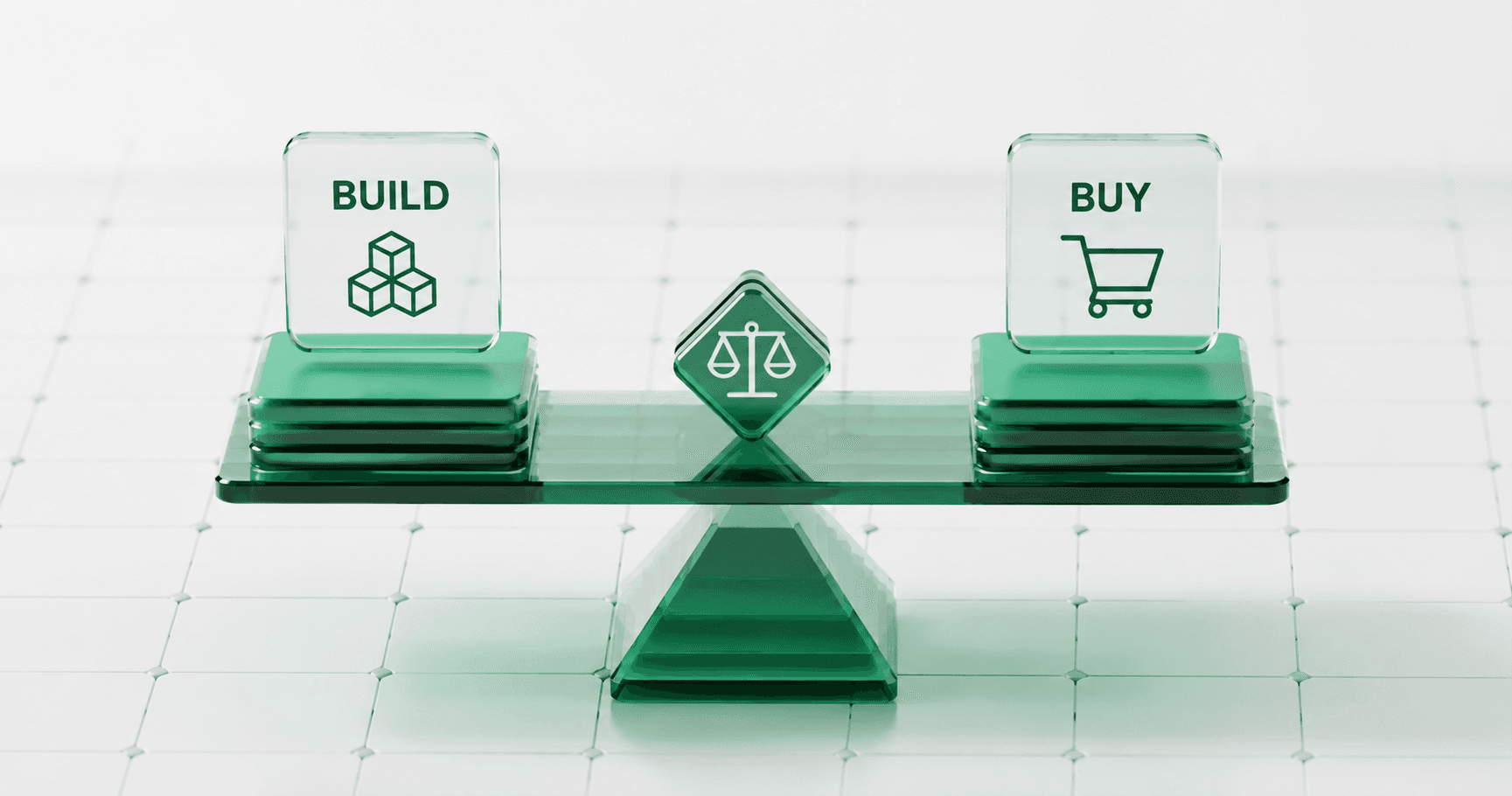
Every enterprise AI procurement decision eventually arrives at the same question: build it ourselves or buy a platform. The question looks strategic. In practice, it is almost always framed too late, by people who have already invested six months in one direction and need a justification, not an analysis.

Mario Baburic
Founder & CEO
I have sat on both sides of that table. As CFO of Infobip, I watched the organisation evaluate, procure, and operationalise infrastructure at scale. As the person who built the foundation of Booga Enterprise from the ground up, I have lived the build side at its most literal. The build vs buy AI platform decision is not binary, and the framework most enterprises use to make it is missing the factors that determine whether the decision holds up two years later.
This article lays out how to think about it properly, including the costs that rarely appear in the original business case and the architectural properties that make the buy decision stick.
Why the build vs buy AI platform question is harder than it looks
The surface-level framing is familiar. Build gives you control, customisation, and no vendor dependency. Buy gives you speed, maintained infrastructure, and someone else's engineering team. The decision tree fits on a slide.
What that framing misses is that AI agent platforms are not conventional software. The build vs buy calculus for a CRM or an analytics tool is based on relatively predictable scope: the feature set is known, the integrations are defined, the maintenance burden is estimable. Enterprise AI agent platforms have a different cost structure on both sides of the ledger.
On the build side, the scope is not stable. LangChain and LangGraph give you orchestration primitives, but building multi-tenant isolation, runtime RBAC, structured audit pipelines, and multi-cloud provisioning on top of those primitives is not a six-week sprint. It is a platform engineering project. The teams that underestimate it consistently do so because they scope the agent, not the infrastructure the agent needs to run on in a regulated enterprise environment.
On the buy side, the risk is not feature gaps at procurement. The risk is architectural lock-in that becomes visible eighteen to twenty-four months later, when the organisation tries to move providers, renegotiate a contract, or satisfy a regulatory audit that the platform's logging model was not designed to support.
The real cost structure of building enterprise AI infrastructure
When an engineering team decides to build an enterprise AI agent platform, the scope they typically estimate covers the agent itself: the model, the tool connections, the retrieval pipeline, the interface. That is the visible part.
The invisible part is everything that needs to exist for that agent to run in a regulated enterprise environment. Tenant isolation at the data layer. Runtime access control that propagates user identity through every tool call, every retrieval, every external API request. Audit trails built as structured event logs rather than model telemetry. Key management that satisfies security review. Multi-cloud deployment that does not require rebuilding the infrastructure when the organisation's cloud contract changes.
Each of these is not a feature. Each is an architectural property that has to be designed into the foundation before the first agent ships, because retrofitting any of them onto a working agent typically costs two to five times the original build. The teams that build the agent first and add governance later are not making a build decision. They are making a deferred-cost decision.
The build option also carries ongoing cost that compounds differently than a subscription. The platform needs to evolve as models change, as compliance requirements shift, and as the enterprise's infrastructure footprint changes. That engineering capacity does not go away after the first deployment. It is the permanent cost of having chosen to own the platform.
The real cost structure of buying an enterprise AI platform
The buy option has a mirror problem. The costs that appear in the procurement case are the licensing fees. The costs that appear later are the ones that determine whether the decision was right.
AI platform vendor lock-in is the most significant of these. Platforms built on a single cloud provider create an infrastructure dependency that becomes expensive to unwind. Platforms with proprietary agent architectures make it difficult to migrate to a different orchestration model without rebuilding the agents. Platforms that bolt governance on at the application layer rather than enforcing it at the data layer create compliance exposure that surfaces during audit rather than during procurement.
The second category of hidden cost is implementation. Enterprise AI platforms require integration work, permission mapping, data source configuration, and ongoing maintenance as connected systems change. For platforms with connector-dependent architectures, every new data source is a new integration project. The platform's listed price rarely reflects this.
The third is the cost of the wrong architectural fit. Buying a platform designed for a different use case and trying to extend it into your actual use case is a version of the build cost, paid twice: once in licence fees and once in engineering.
The four questions that determine which decision is right
The build vs buy decision reduces to four questions that most enterprise AI strategy frameworks do not ask explicitly. Each one maps to a category of cost that only becomes visible after the decision is made.
1. What is your governance posture, and who enforces it?
If your deployment will face a security review that asks how agent actions are authorised at the data layer, whether tenant isolation is enforced architecturally or by convention, and whether audit trails are system-of-record events or model telemetry reconstructions, then your governance posture is a first-class architectural constraint. A platform that does not build governance into its foundation cannot satisfy this review without a rebuild. A build decision that does not start from governance will produce the same problem. The question is not whether you need governance. The question is who is responsible for building and maintaining it.
2. What is your infrastructure constraint?
Enterprises with data residency requirements, regulated data classifications, or multi-cloud mandates cannot use platforms that assume a single cloud deployment model. If your organisation runs on Azure in Europe and AWS in the US, a platform that runs on one cloud is not a platform you can fully deploy. The infrastructure constraint is often treated as a secondary consideration during procurement and becomes the primary cost driver after contract signature.
3. What is your time horizon and how do you value optionality?
Build decisions are capital-intensive upfront and produce a proprietary asset that retains optionality: you own the platform, you control the roadmap, and you are not exposed to a vendor's pricing or acquisition decisions. Buy decisions are lower upfront cost and higher ongoing cost, with the added risk that the vendor's roadmap diverges from your requirements. The right time horizon depends on how central AI agent infrastructure is to your competitive position. If it is core infrastructure, build or buy a platform you can own. If it is a tool, buy a managed solution and accept the constraints.
4. What does it cost to be wrong?
The build vs buy decision is not permanent, but reversing it is expensive. A build decision that underestimates the platform engineering scope produces an organisation that has spent twelve to eighteen months building infrastructure instead of deploying agents, and then faces the same buy decision from a worse position. A buy decision that locks in the wrong architectural model produces an organisation that is paying for a platform it cannot fully use and cannot easily exit. Mapping the cost of being wrong in each direction, explicitly and with specific assumptions, produces a better decision than comparing feature lists.
What the survivors of this decision get right
The enterprises that make the build vs buy AI platform decision well and do not revisit it two years later share a consistent pattern: they treat governance, portability, and audit as procurement requirements, not post-deployment configurations.
On the buy side, that means requiring tenant isolation at the data layer rather than accepting namespace separation. Requiring runtime RBAC that propagates user identity through agent actions rather than accepting application-layer filtering. Requiring structured audit event logs with configurable retention rather than accepting model telemetry reconstructions. Requiring multi-cloud deployment as a first-class capability rather than accepting a portability promise in the contract.
On the build side, it means starting the architectural design from the governance requirements rather than from the agent's functional requirements. The platforms built to last are the ones where governance was the first constraint, not the last feature.
The platforms that Booga Agents is built to serve are organisations in the second category: enterprises that treat AI agents as production infrastructure, need governance at the architectural layer, and require the ability to run where their data already lives. The [governance architecture behind Booga Agents](https://boogaenterprise.com/blog/ai-contextual-governance) is not a feature set added to a working agent platform. It is the foundation the agent platform is built on.
Evaluating enterprise AI infrastructure decisions? Read how Booga Agents approaches governance by design at boogaenterprise.com
FAQ
What is the build vs buy decision for AI platforms?
The build vs buy decision for enterprise AI platforms is the choice between building proprietary AI agent infrastructure in-house versus procuring a platform from a third-party vendor. Unlike conventional software procurement, the decision involves hidden costs on both sides: the build option carries a platform engineering scope that is consistently underestimated, and the buy option carries architectural lock-in and compliance risks that are not visible in the procurement case. The decision framework requires explicit analysis of governance posture, infrastructure constraints, time horizon, and the cost of being wrong.
When does building your own AI platform make sense?
Building your own AI agent infrastructure makes sense when AI is core to your competitive position, you have the platform engineering capacity to maintain it over time, and the governance requirements of your deployment are specific enough that no available platform satisfies them without significant customisation. It does not make sense when the scope estimate covers the agent but not the infrastructure the agent needs to run on in a regulated environment. The teams that build the agent and add governance later consistently find that retrofitting governance costs two to five times the original build.
What is AI platform vendor lock-in and how do you avoid it?
AI platform vendor lock-in is the dependency created when an enterprise's AI agent infrastructure is built on proprietary abstractions, single-cloud deployment models, or agent architectures that cannot be migrated without a rebuild. It becomes visible when the organisation tries to renegotiate a contract, change providers, or satisfy a regulatory requirement the platform was not designed to support. Avoiding it requires treating multi-cloud deployment, LLM provider portability, and data export standards as procurement requirements rather than post-contract negotiations.
What should enterprise leaders require from any AI platform they buy?
Four requirements that determine whether the buy decision holds up: tenant isolation enforced at the data layer rather than by namespace convention; runtime RBAC that propagates user identity through every agent action rather than filtering at the application layer; audit trails built as structured event logs with configurable retention rather than model telemetry reconstructions; and multi-cloud deployment as a first-class capability rather than a single-vendor SaaS model with an optional bring-your-own-cloud clause.
Mario Baburic
Founder & CEO
Share


