Blog
Insights
AI Assistant vs AI Agent: What the Difference Actually Means for Your Work
AI assistant vs AI agent: what the difference actually is, why it changes what AI can do for business teams, and how to know which one you need.

Mario Baburic
Founder & CEO
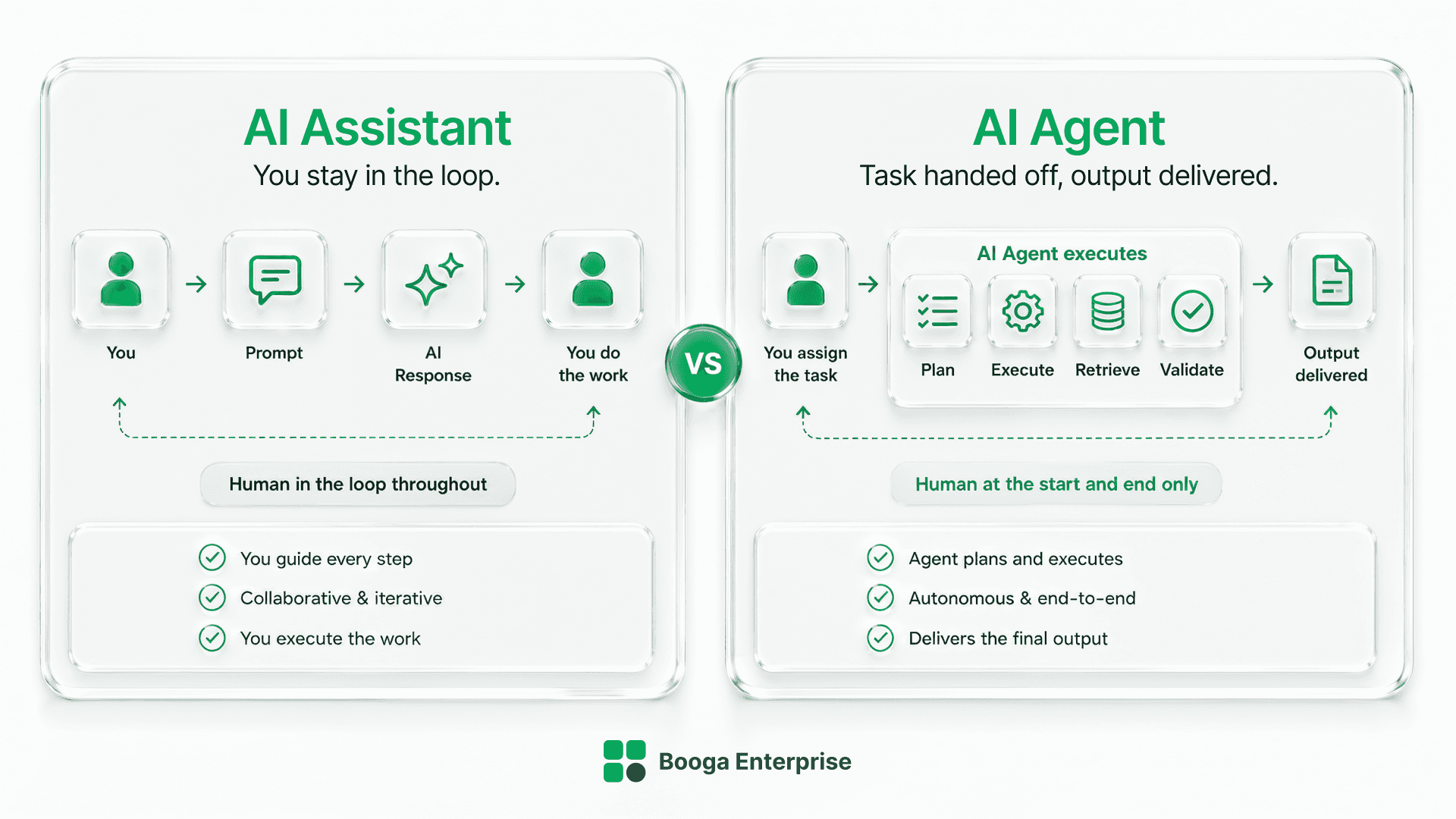
Most people who use AI at work are using an assistant. They type a question, the assistant responds, they type another question. The exchange is useful. It saves time on writing, summarising, researching. But it ends when the conversation ends. The next task starts from scratch.
An AI agent works differently. It does not wait for the next question. It takes a task, breaks it into steps, executes those steps using the tools and information available to it, and delivers a result. The person who assigned the task may not be involved again until the result arrives.
The AI assistant vs AI agent distinction is not a matter of degree. It is a different model of how AI fits into work. Understanding it helps clarify which category of tool is appropriate for which kind of task — and why the category matters for how much time AI actually saves your team.
What an AI assistant does — and where AI assistant vs AI agent diverges
An AI assistant responds to prompts. You give it context, ask a question or assign a task, and it produces a response. The interaction is conversational and synchronous: you are present throughout, you provide direction, and the output reflects the inputs you gave in that session.
Assistants are well-suited to tasks where your judgement is the primary input and the AI's contribution is execution: drafting text you then review and edit, summarising a document you provide, generating options you then choose between, answering questions where the relevant information is either in the conversation or in the model's training.
The limitation of the assistant model is that it is bounded by the conversation. It does not carry context from previous sessions unless you provide it explicitly. It does not take actions in other systems. It does not run on a schedule. When you close the window, the work stops.
What an AI agent does differently
An AI agent is not waiting for the next prompt. It has a goal, a set of tools it can use to pursue that goal, and the ability to sequence actions to reach it. When you assign a task to an agent, you are handing off the task, not initiating a conversation.
In practical terms, that means an agent can retrieve information from your knowledge base, apply logic to it, format an output, send it to the right place, and do this on a schedule without anyone in the loop. A research agent can monitor a set of documents for relevant changes and produce a weekly briefing. A reporting agent can pull data from connected sources, format it into a standard template, and deliver it every Monday morning. A workflow agent can receive a trigger, process the input, route the output, and log the action — all without a human in the loop.
The agent model is appropriate for tasks that are well-defined, recurring, and time-consuming to do manually. If you find yourself doing the same multi-step task repeatedly, the question worth asking is whether that task can be described clearly enough that an agent can be configured to do it on your behalf.
The practical difference for business teams
For most business teams, the distinction manifests in one question: does the AI tool do things, or does it help you do things?
An assistant helps you do things. You draft an email with it, write a document with it, think through a problem with it. The output requires your involvement throughout and ends when you stop engaging.
An agent does things. You describe a task, set the parameters, and the agent executes. You receive the output. Your involvement is at the beginning and the end, not throughout.
The difference in time saved is significant. An assistant might save you an hour on a task you then complete yourself. An agent might complete a recurring task that previously took three hours every week, every week, without your involvement.
The category of task that benefits most from agents: anything recurring with defined inputs and outputs. Anything that requires pulling information from multiple sources and synthesising it. Anything that needs to happen on a schedule regardless of whether you remember to trigger it. Anything that produces a standard output format that does not require judgement to produce but does require time.
Why the AI assistant vs AI agent distinction matters for what you buy or build
Most AI tools marketed to business teams are assistants with agent features added. The core interaction model is conversational. The agent capabilities are extensions: you can set up some automation, connect some tools, run some scheduled tasks. For simple use cases, this is enough.
Platforms built on the agent model start from the opposite premise. The core unit is not the conversation. It is the agent: a configured set of goals, tools, knowledge sources, and execution rules that runs on your behalf. The conversational interface is a way to build and refine agents, not the primary mode of work.
For teams whose primary use case is recurring, structured business work, the agent-first model produces more useful outcomes with less ongoing involvement. You spend time configuring the agent once rather than prompting the assistant each time the task needs to be done.
Booga One is built on the agent-first model. The AI Agent Builder lets you describe in plain English what you want an agent to do, and the platform builds a configured workflow from that description. The Visual Workflow Builder lets you see and adjust the workflow step by step without writing code. The Knowledge module makes your documents available to the agent as a searchable source — grounded in your company's actual data, not public information. The Scheduler runs agents on whatever cadence your work requires. The Intelligence Layer carries context between sessions so the agent understands your preferences and prior work without being re-briefed.
Booga One is currently in private beta. Teams that want to evaluate the agent model for their specific workflows can apply for beta access at boogaenterprise.com.
How to know which model your team needs
Three practical questions help clarify whether an assistant or an agent model is the right fit for a given use case.
First: is the task recurring? One-off tasks with variable inputs are better suited to an assistant. Recurring tasks with defined inputs and expected outputs are better suited to an agent.
Second: how much human judgement does the task require mid-execution? Tasks that require active decision-making throughout are assistant tasks. Tasks where the judgement is in the setup and the execution is mechanical are agent tasks.
Third: how much does it cost to have a human in the loop every time? If a recurring task takes thirty minutes of skilled time every week, automating it with an agent produces thirty minutes of reclaimed capacity every week indefinitely. That accumulates. If a task takes five minutes once a month, the overhead of configuring an agent probably does not justify it.
Most business teams have tasks in both categories. The practical approach is to identify the recurring, high-time-cost tasks first, evaluate whether they meet the criteria for agent automation, and start there. The assistant handles everything else.
Booga One is in private beta. Apply for access at boogaenterprise.com →
FAQ
What is the difference between an AI assistant and an AI agent?
An AI assistant responds to prompts in a conversational model. You provide input, it produces output, and the interaction ends when the conversation ends. An AI agent takes a task, sequences the steps required to complete it using available tools and information, and delivers a result — often without requiring the user to be involved throughout execution. Assistants are appropriate for tasks requiring active human judgement throughout. Agents are appropriate for recurring, structured tasks with defined inputs and expected outputs.
What can AI agents do that AI assistants cannot?
AI agents can run on a schedule without being prompted. They can retrieve information from knowledge bases, apply logic to it, and produce outputs in standard formats. They can trigger actions in connected systems, route outputs to the right destination, and log what they did. Assistants are bounded by the conversation: they do not act autonomously, do not run without prompting, and do not carry context between separate sessions unless explicitly provided.
Do I need to write code to use an AI agent builder?
Purpose-built AI agent platforms designed for business teams do not require code. The conversational AI Agent Builder in Booga One, for example, converts a plain-English description of what you want the agent to do into a configured workflow. The Visual Workflow Builder provides a drag-and-drop canvas for reviewing and adjusting the workflow step by step. Neither requires writing code. Developer-first frameworks like LangChain and CrewAI require coding and are designed for engineers building custom agent infrastructure.
What kinds of business tasks are best suited to AI agents?
Tasks that are recurring, have defined inputs and expected outputs, and currently require skilled time to execute manually are the best candidates for AI agents. Examples: weekly research briefings synthesised from monitored documents, recurring reports generated from connected data sources, workflow routing tasks that receive inputs, apply logic, and deliver outputs to defined destinations, and scheduled tasks that need to happen reliably regardless of whether a team member triggers them.
Mario Baburic
Founder & CEO
Share


